Triathlon is an expensive sport, and some of the purchases that feel most closely linked to getting faster are the ones that give the least back. I am Phil Mosley, head coach at MyProCoach, and in more than 20 years of coaching and racing I have made expensive mistakes in several of the areas below, usually because I spent before I had thought clearly about the benefit.
This guide follows my video on the five biggest wastes of money in triathlon. Several of these items can be good value when you choose well, so I have set out when each one earns its place and when it does not. You can watch the video, read the post, or do both.
Key takeaways
- The best carbon super shoe for most athletes is the pair that fits, feels fast and comfortable when you are tired and lasts long enough to justify the cost, which is not always the newest model.
- Small aero bike parts are hard to verify, and your body position usually has far more effect on drag than a plastic cover or a different computer mount.
- Supplements can help with a confirmed deficiency such as low iron, but adding products one by one without knowing what they do can cost around £40 ($50) a month with little return.
- A decent race suit costs about £100 to £500 (up to $600) and most athletes race two or three times a year, so one good suit in the middle of your size range is usually enough.
- Race entries are the biggest waste of money in my experience, because races sell out six months to a year ahead and life changes, so take race insurance if it is available and understand deferral options before you enter.
Carbon super shoes: buy a pair that fits and lasts, then resist the upgrade cycle
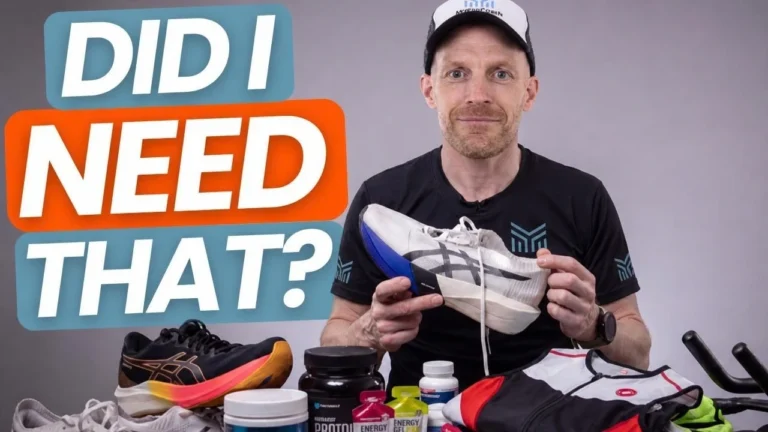
Carbon super shoes have changed running and triathlon. Course records have fallen and world records have improved, and age group athletes are running times they might not have thought possible a few years ago. I am grateful for that technology too, because as I get older I feel that good racing shoes help my run times decline more slowly than they otherwise might.
I have also wasted quite a lot of money on them. Most recently I bought a pair of ASICS Superlite racing shoes for the London Marathon. They felt fast when I first tried them on, but during the race they crushed my toes so badly that I had to change the way I ran. I have also owned a few pairs of Nike super shoes, including the AlphaFly 3, that were fast and comfortable but had a rubber outsole that started peeling away after only a few runs. If a shoe starts falling apart before you have had proper value from it, it becomes an expensive mistake, however quick it feels.
The other trap I fall into is the upgrade cycle. Every year the latest version promises to be a little lighter and faster, and it is easy to feel at a disadvantage if you are not wearing the newest model. I am gradually learning that the best super shoe for most of us is the one that fits your foot, feels fast and comfortable when you are tired and lasts long enough to justify the cost. Find a comfortable pair you know you can race well in, and do not replace it just because a new version has come out. A shoe that saves a few seconds but gives you blisters or crushed toes, or falls apart quickly, is not saving you anything.
Small aero bike parts: sort your position first, then test properly
One thing I am particularly bad at is buying random bike bits that I think might make me faster. If something promises to save five watts of aerodynamic drag, I am suddenly interested. Over the years that has included an aerodynamic chainring cover, a derailleur cover that stopped my gears working properly and a Garmin bike mount that was supposedly more aerodynamic than a standard one.
There is nothing wrong with trying to make your bike faster. Aerodynamics matters in triathlon, and if you can reduce drag without compromising comfort, safety or reliability, that can be a sensible investment. The difficulty is that small aerodynamic claims are very hard to verify. Airflow around a moving cyclist is complicated, and one change can affect another, so a bolt-on part that looks faster may not make you faster in your position, with your bottles, helmet, clothing and riding style. Without an objective way to measure the difference, you are guessing.
Start with your body position, which usually contributes far more to drag than a small plastic cover or a different computer mount. Once your position is comfortable and sustainable, and as aerodynamic as you can make it, equipment testing makes more sense. At the top end that can mean a wind tunnel, where your drag is measured directly. A velodrome lets you ride repeated laps and compare changes in position or equipment against speed and power. You can also buy on-bike aero sensors that estimate your drag while you ride outside, although they still need careful, consistent testing conditions to be useful. Saving five watts in theory is not much help if the part makes your bike harder to ride or maintain, or less reliable on race day. For more on where the real time savings are, see our guide to cycling aerodynamics and time savings.
Supplements and endurance nutrition: fix the basics before buying products
This is one area where spending can creep up without you noticing. There are many tablets, powders, drinks, gels, chews, bars and capsules that promise to support your training and racing, and I do not want to dismiss all of them. If you have a confirmed deficiency, a supplement such as iron can help. If you are racing a long-distance triathlon, gels, energy drinks, sodium tablets and other race nutrition can be very important, and you need to practise with whatever you plan to use on race day. Our IRONMAN 70.3 bike pacing guide explains how pacing and fuelling work together.
The waste begins when you buy products you do not really need. You might take magnesium for cramps, collagen to support your tendons, beetroot juice to improve endurance or creatine to boost strength and recovery. None of these is automatically a bad choice, but if you add them one at a time without knowing what each is doing for you, you can end up with a cupboard full of products and no idea what is helping. If you sleep six hours a night, miss meals after training, under-fuel your long rides or do too many hard sessions, a new powder or capsule is unlikely to fix that. You might spend £40 or $50 a month on a supplement when a decent breakfast before training, more consistent meals, better recovery habits or simply arriving at key sessions feeling fresher would return more.
The same applies to endurance nutrition. Gels, chews, electrolyte powders, bars and carbohydrate drink mixes have a time and place, especially in races and in the longer sessions where you rehearse your race day fuelling. If you use branded endurance nutrition for every easy swim, short ride, steady run or gym session, you are probably spending a lot of money for little benefit. For normal days, cheaper foods and drinks from the supermarket often do the job well, as long as they sit comfortably in your stomach and suit the purpose of the session.
Race suits: buy one good suit and stay with it
A good triathlon race suit is an important piece of kit. You can swim, ride and run in it without wasting time changing during a race. The difficulty is that race suits are expensive and you do not wear them often. A decent suit costs anywhere between $100 and $600. Between my wife and me we must have about six. I have three myself, two MyProCoach ones and a plain one, and I have ordered a fourth because I qualified for the T100 World Championships, where I need to wear national team kit.
If I wore those suits every week, like running shoes, the cost would be easier to justify. Most of us race two or three times a year, and some years only once or not at all. The suit sits in a drawer for most of the season while technology moves on, styles change and your body shape may change slightly too. My advice is to buy one good race suit and stay with it. Choose a size in the middle of your range rather than right on the limit, go for a colour and style that will not date quickly, and make sure it suits the type of racing you actually do. You do not need a wardrobe full of race suits to be a good triathlete. You need one that fits, carries your nutrition, feels comfortable in all three disciplines and lets you race without thinking about it.
Race entries: the purchase that wastes the most money, and how to protect it
In my experience, race entries are the biggest waste of money in triathlon, and that is a difficult thing to say because they can also be among the best things you spend money on. An entry gives you a target and structure for your training, and it can motivate you over several months to become capable of something you could not do before. Race days can also be some of the most memorable experiences of your life. Personally, if I do not enter two or three races a year I find it harder to train effectively and to eat healthily, and having something on the calendar helps me make better decisions about my life and health.
The waste comes when you cannot make the start line, and triathlon makes that more likely because many races sell out early. You end up entering six months, nine months or even a year in advance, when you do not know what your life will look like. You might buy a house that needs renovating, become a parent, or see your family commitments, work or sporting goals change. In my case I entered a marathon and then qualified for the T100 World Championships, which take place seven weeks after it. Racing the marathon hard would leave me fatigued and heavy-legged in the key training weeks for the T100, so an entry that seemed a good idea at the time is now one I probably will not use. That is before illness and injury. Over the years I have wasted a lot of money on entries I could not use, usually because I was ill or injured at exactly the wrong moment.
My advice now is simple. If race insurance is available, consider taking it. If a deferral option exists, understand it before you enter. When you book travel and accommodation, choose options that do not force you to pay the full amount if you cannot make it. If you want a plan to build towards the races you do enter, you can see our triathlon training plans.
Frequently asked questions
They can be, if the pair fits your foot, feels fast and comfortable when you are tired and lasts long enough to justify the cost. I am grateful for the technology, but I have also wasted money on a pair that crushed my toes during a marathon and a pair whose outsole started peeling after a few runs. Avoid upgrading just because a new version has been released.
They might, but small aerodynamic claims are very hard to verify, because one change can affect another and results depend on your own position, bottles, helmet and clothing. Your body position usually has a much bigger effect on drag than a plastic cover or a computer mount, so sort that first. After that, a wind tunnel, a velodrome or on-bike aero sensors used in consistent conditions can give you real evidence.
Not automatically. A confirmed deficiency, such as low iron, can justify a supplement, and race nutrition such as gels, drinks and sodium tablets matters in long races and should be practised in training. Adding products one at a time without knowing what they do for you can cost around £40 ($50) a month. Sleep, regular meals, good recovery and well-fuelled key sessions usually return more.
One good race suit is enough for most athletes. A decent suit costs about £100 to £500 (up to $600) and most people race two or three times a year. Choose a size in the middle of your range rather than on the limit, pick a colour and style that will not date quickly, and make sure it suits the type of racing you actually do.
Consider race insurance if it is available, understand the deferral options before you enter, and choose travel and accommodation that do not make you pay in full if you cannot make the start. Many races sell out early, so you may enter six months to a year ahead, long before you know what your life will look like. Illness and injury are the usual reasons an entry goes unused, along with changes at work or home.