Carbon-plated racing shoes are now a common sight at triathlon start lines, and it is hard to tell whether the extra cost buys a faster run or a shoe that causes problems you did not have before. The answer depends on your goal, your course and how you plan to use them.
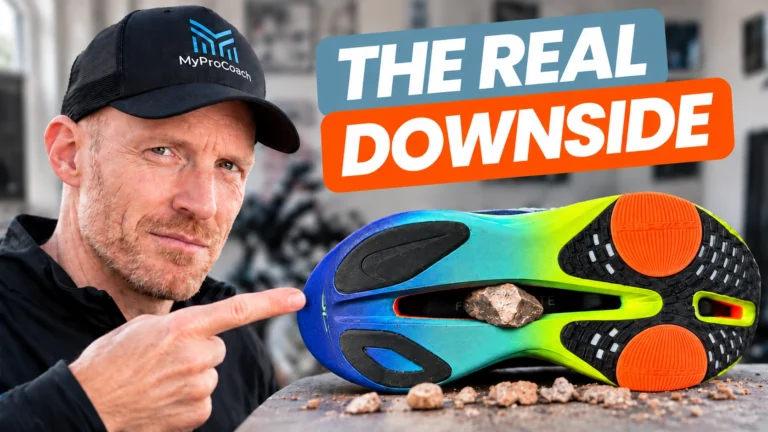
I wear carbon shoes for most of my triathlons, and I have also had to stop 14 times in a single run to dig stones out of them. This piece follows a video I made about this and sets out what the shoes do, what the research says, what a 1% gain is worth over each race distance and when I think a pair is worth buying.
Key takeaways
- A carbon super shoe is a whole race-day design: a carbon fibre plate, a light and springy foam such as PEBA or PEBAX, a minimal outsole and a thin mesh upper. The foam matters as much as the plate.
- One well-known early lab study found super shoes cut the energy cost of running by around 4%. More recent reviews suggest 2 to 3%, depending on the shoe, the runner, the pace and the comparison shoe, and a lower energy cost does not mean you run the same percentage faster.
- A 1% gain is worth about 15 seconds over a 5 km (3.1 mile) sprint triathlon run for a 25-minute runner, about 36 seconds over 10 km (6.2 miles) for a 60-minute runner and about 2 minutes 24 seconds in a 4-hour marathon.
- The shoes make most sense when you are chasing a time or a podium place, trying to qualify, or racing a longer event where protecting your legs late in the run matters, and less sense on a twisty, rough or partly off-road course.
- Triathlon adds practical problems: slower transitions, elastic laces and instability on tired legs, minimal outsoles that collect stones, fast wear and thin mesh uppers that can rub without socks. Test them in race conditions before race day.
The foam matters as much as the carbon plate
Carbon running shoes, often called super shoes, are racing shoes built around a few key features. The obvious one is the carbon fibre plate that sits inside the midsole and controls how the shoe bends. It gives the shoe stiffness through toe-off, and when it suits your running style it helps you roll forward more efficiently at race pace.
The bigger change compared with old-style racing flats is probably the foam. Modern super shoes often use very light, springy foams such as PEBA or PEBAX-based materials. Years ago, a light racing shoe usually meant something thin, firm and unforgiving, and more cushioning normally meant more weight. These foams let manufacturers build a shoe with a high stack height and plenty of cushioning that is still light enough to race in.
The makers also strip weight from almost everywhere else. The outsole has very little rubber and hardly any tread, the upper is thin breathable mesh, and the tongue, heel padding and laces are pared back as far as possible. When you pick up a pair, you are looking at a whole race-day design with plenty of cushioning and low weight. The same features that make these shoes fast can make them less practical in triathlon racing and training.
Lab research points to savings of about 2 to 4% in the energy cost of running
One of the best-known early studies on super shoes found that they reduced the energy cost of running by around 4% in the lab. More recent reviews suggest the average reduction is closer to 2 or 3%, depending on the shoe, the runner, the pace and the shoe it is compared with. That does not mean you will run 2, 3 or 4% faster. If a shoe helps you use less energy at a given pace, some of the saving might help you run faster and some might help you feel less beaten up, hold your form for longer or fade less towards the end.
That is relevant in triathlon because you do not start the run fresh. You start after the swim and the bike, possibly with wet feet, elastic laces and a high heart rate, and you are trying to get your shoes on quickly in transition. Then you run on whatever surface the organiser gives you, which might include tight turns, uneven paths, aid stations, ramps, carpet, gravel or rough roads. So the evidence is encouraging, but you still have to apply it to triathlon running, which is different from racing a 10 km or a marathon on a flat road.
Real-world results point the same way. Elite marathon times have moved forward quickly, and world records have fallen for both men and women, with the men’s record now officially under two hours. We are seeing IRONMAN marathons completed in under 2 hours 30 minutes and IRONMAN 70.3 run splits close to 67 minutes for 21.1 km (13.1 miles). Modern shoes are not the only reason for that improvement. Training, racing, pacing, course choice, the depth of the athlete field and professionalism all make a big difference. It would still be difficult to argue that footwear has not played a major part.
A 1% gain is worth seconds in a sprint and minutes in an IRONMAN
For age group triathletes, I think it is better to think in small percentages than to expect miracles. I am using 1% as a basic example. I am not saying that is exactly what you will get, but it is a reasonable way to think about the potential benefit.
| Run leg | Typical run time | Time saved with a 1% gain |
|---|---|---|
| Sprint, 5 km (3.1 miles) | 25 minutes / 20 minutes | About 15 seconds / 12 seconds |
| Standard, 10 km (6.2 miles) | 45 minutes / 60 minutes | About 27 seconds / 36 seconds |
| IRONMAN 70.3, 21.1 km (13.1 miles) | 1 hour 45 / 2 hours | About 1 minute / 1 minute 12 seconds |
| IRONMAN, 42.2 km (26.2 miles) | 4 hours | About 2 minutes 24 seconds |
In a sprint, that is useful if you are racing for a podium place, but it will not change your day. In an IRONMAN 70.3 the numbers start to become more meaningful, and if the shoes give you closer to 2%, you could be looking at 2 minutes or more. In a full IRONMAN the saving is bigger again: for a 4-hour marathon, 1% is about 2 minutes 24 seconds and 2% is close to 5 minutes.
That is why the answer to “should I use carbon shoes?” depends a lot on your goal. If you are trying to win your age group, qualify for an age group world championship or break a specific time barrier, then 1 or 2 minutes can be huge. If your main goal is to finish comfortably, enjoy the race and come away proud of your day, the extra cost and compromise may not be worth it. I use carbon shoes for most of my triathlons because I am usually trying to win my age group or qualify for a world championship, so every second counts. If I turned up on race morning and realised I had left them at home, I would be annoyed with myself.
Carbon shoes bring practical problems that show up on race day
Carbon shoes are designed for speed first. Triathlon needs speed and practicality, and the first issue appears in transition. Some carbon shoes are hard to get on quickly, with narrow openings, delicate uppers, thin tongues and heel shapes that do not help when you are pushing your foot in after getting off the bike. Many triathletes use elastic laces to make this easier, which I understand, but elastic laces can make an already unstable shoe feel less secure. A high stack height, extra soft foam, low weight, a narrow platform and elastic laces can add up to a shoe that feels quick in a straight line but is not very stable around corners. On tired legs, when your coordination is not as good as it was at the start of the day, that stability matters. Our guide to triathlon transitions covers the rest of the process.
The outsole is the next thing to consider. Manufacturers save weight with minimal tread and small patches of rubber, which keeps the shoe light and fast but makes it less versatile. I learned this at the Alpe d’Huez Triathlon in France, where the run included a stony section and I was wearing Nike Alphafly 3 shoes. They have a weight-saving cutaway in the outsole, the stones kept getting stuck inside it, and I had to stop 14 times to pick them out.
Wear is a further issue. Unless you are prepared to buy two pairs, you cannot realistically train in them very often before race day, because they wear out quickly. Every shoe is different and some last better than others, but I have had super shoes where the rubber outsole wore through to the foam after just six runs. You need to practise in them enough to know they work, but not so much that you have ruined them before your race.
The last practical issue is socks. In standard distance triathlons and shorter races, many triathletes skip socks because it saves time in transition. That can work well in some shoes, but carbon racing shoes often have very thin mesh uppers that you can almost see through, with few comfort features. They are designed to save weight and not to feel pleasant against wet bare feet after a swim and a bike ride. If you plan to race sockless in them, test it properly beforehand. If they rub in training, they will not become comfortable on race day. Our guide on what to wear for a triathlon has more on race-day kit.
Carbon shoes suit athletes who are chasing a time, a place or a longer run
I do not think carbon shoes should be seen as something only professional triathletes or top age groupers are allowed to use. Plenty of everyday age group athletes can benefit from them, and they do make you faster, but the benefit matters more in some situations than in others.
They make the most sense if you are chasing a time, racing for a position, trying to qualify, or doing a longer event where protecting your legs late in the run could really help. They make less sense if you are newer to running, if you already struggle with ankle stability, or if your race course is twisty, rough or partly off-road. They are also not something to use for your daily training.
Fitness, fuelling and pacing come first, then the shoes
A pair of carbon shoes might save you a minute, but turning up fitter, fresher, better fuelled and better paced could save you far more. Shoes matter, but they sit on top of the basics and they do not replace them. That is also why, when we build training plans at MyProCoach, the priority is to help you train consistently, recover properly and arrive at the start line ready to race well. Carbon shoes can help, and they work best when the training underneath them is solid.
My verdict is that carbon shoes are worth it for age group triathletes, but not automatically and not for everyone. They are most worthwhile when the course suits them, the shoe fits you well, you feel stable in them and you have tested them in triathlon conditions. The possible time saving also has to matter to you and your goal. They are less worthwhile when they make transitions harder, rub your feet without socks, feel unstable on tired legs, collect stones or cost more than your budget allows. For me they are worth it, because I am normally chasing every second I can find, and I know their limitations now. If you are weighing up the cost, our guide to the biggest wastes of money in triathlon covers how to avoid the upgrade cycle, and our triathlon training plans are built around the training that sits underneath the shoes.
Frequently asked questions
Yes for many age group triathletes, but not automatically and not for everyone. They are most worthwhile when you are chasing a time or a podium place, or trying to qualify, and the course suits them, the shoe fits well, you feel stable in them and you have tested them in triathlon conditions. They are less worthwhile if they make transitions harder, rub without socks, feel unstable on tired legs or cost more than your budget allows.
A realistic range to plan around is about 1 to 2% on the run. Lab studies suggest super shoes reduce the energy cost of running by about 2 to 4%, but that does not translate directly into the same gain in speed. A 1% gain is about 15 seconds over a 5 km (3.1 mile) run for a 25-minute runner, about 1 minute over an IRONMAN 70.3 half marathon for a runner finishing in 1 hour 45 and about 2 minutes 24 seconds in a 4-hour marathon.
You can, but test it properly in training first. Carbon racing shoes often have very thin mesh uppers with few comfort features, and they are designed to save weight, so they may rub against wet bare feet after a swim and a bike ride. If they rub in training, they will not become comfortable on race day.
It varies between models, but they can wear out quickly. I have had a pair where the rubber outsole wore through to the foam after about six runs. Unless you are prepared to buy two pairs, you need to practise in them enough to know they work without using them up before race day, and they are not suited to daily training.
Usually not at first. Carbon shoes make less sense if you are newer to running, if you struggle with ankle stability, or if your race course is twisty, rough or partly off-road. Being fitter, fresher, better fuelled and better paced can save far more time than a pair of shoes, so build those basics first.