Most IRONMAN 70.3 races are either set up well or spoiled on the bike, long before the run begins. I struggled at this distance for years and wondered whether I was better suited to shorter triathlons. Getting a power meter and learning to hold back early in the race changed that, and I started running well off the bike and winning my age group at IRONMAN 70.3 events.
This guide covers pacing from the swim start to the finish line, with bike and run targets by finish time using power, heart rate or perceived effort. It follows the video below, so you can watch it, read it, or do both.
Key takeaways
- The aim of an IRONMAN 70.3 is to still feel strong three, four or five hours into the race, so the first half should feel controlled and sometimes almost too easy.
- Bike pacing should come from what you have shown consistently in recent training.
- A sensible starting point on the bike is about 83 to 84% of FTP for a sub-5 hour finish, 80 to 82% for 5 to 6 hours, and 77 to 80% for 6 to 8 hours.
- Riding too hard makes it harder to absorb fuel and fluid, because your body sends blood to the working muscles ahead of the gut.
- Start the run slightly slower than feels natural. A 5 to 6 hour athlete might run at about 87 to 89% of threshold heart rate, then build gradually after halfway.
Pacing an IRONMAN 70.3 means staying strong for four to eight hours
An IRONMAN 70.3 is made up of a 1.9 km (1.2 mile) swim, a 90 km (56 mile) bike ride and a 21.1 km (13.1 mile) run. Depending on your level, that can take anywhere from around 4 hours to 8 hours. Even for a strong age grouper it is a long endurance event, and small pacing mistakes come back later in the race.
Almost everyone can feel strong for the first half. The goal is to still be feeling strong three, four or five hours in, when your legs are tired, your stomach is working hard and you have a half marathon still to run.
Three pacing mistakes that cost time on the run
The first mistake is starting without a realistic pacing strategy. Without one it is very easy to push a little too hard in the first half, especially because it does not feel that hard at the time.
The second is setting separate time goals for the swim, bike and run based on your best-case scenarios. That looks good on paper, but it leaves no room for race day conditions, fatigue, nutrition or the cumulative effect of doing all three disciplines back to back. You can end up chasing target times that leave you exhausted, or downhearted when you miss them.
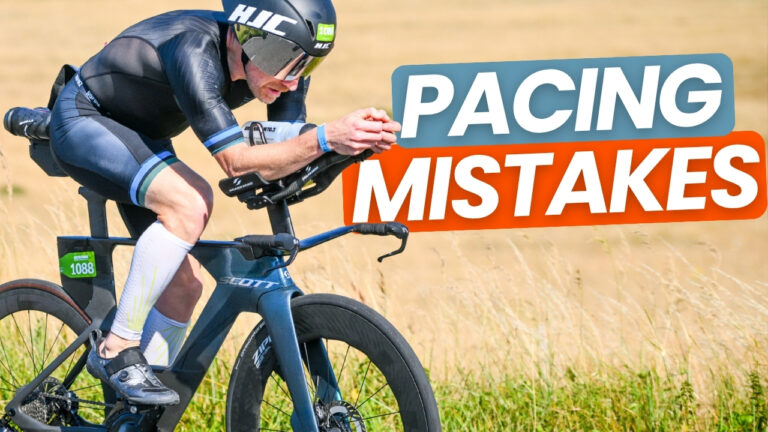
The third is riding too hard up hills, out of corners or in short bursts. In an IRONMAN 70.3 you are nearly always better off keeping your effort controlled. Those harder efforts may not feel bad at the time, but they create muscle damage that you pay for on the run.
I have made all of these mistakes myself. My swimming was weaker than my cycling, so I would spend the whole bike leg trying to catch up the time I had lost in the water. That is a poor strategy at this distance. Pacing an IRONMAN 70.3 takes discipline and humility. Sometimes you have to let people go, whether that is the swimmers who beat you out of the water or the cyclists who surge past on the first climb. In the early stages the right effort may feel almost too easy, and that is usually what lets you race properly later on.
How hard to swim and how to move through transition
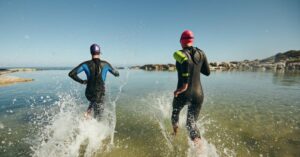
The swim is the hardest part of the race to pace accurately, because you cannot keep checking your watch as you can on the bike or run. The first few minutes can be messy, with swimmers close by, bubbles, feet everywhere and some contact around the buoys. Aim for an effort that feels controlled but purposeful, about 7 out of 10 intensity. It should never feel like a panic. If you are struggling to breathe or feel as though you are fighting the water, you have probably started too hard.
One cue I come back to is breathing out fully on each stroke. A lot of swim panic comes from holding your breath and then trying to gasp in more air. Once the field spreads out, ease back to about 6 out of 10 for the main part of the swim. You are setting yourself up for the rest of the race.
After the swim it is easy to run too fast towards the transition area. Race data suggests that many triathletes’ heart rates peak during the transitions, with people sprinting, wrestling with wetsuits and fumbling with helmets as though the whole race depends on those few seconds. For most age group athletes, transition is a poor place to create extra stress and fatigue. Move with purpose and go through at the pace you want to hold for the whole race, because this is a four to eight hour event.
IRONMAN 70.3 bike pacing: two rules and targets by finish time
The bike is where you have the biggest chance to either strengthen your race or damage it. A 90 km (56 mile) ride is long enough to create a lot of fatigue, and short enough to tempt you into riding too hard. You feel strong, you are overtaking people and you start to think it might be a really good day. Sometimes it is, but very often you are not gaining time. You are borrowing it from the run.
The first rule is to base your plan on what you have shown consistently in recent training. That evidence comes from long rides, race-specific sessions, brick workouts and intervals, ideally on similar terrain, in a similar position, with similar equipment and on your race day bike. If you follow one of our IRONMAN 70.3 training plans, use the results of the fitness tests in the plan together with the pacing guidelines you will find in the final couple of weeks.
The second rule is to keep your effort smooth. Spikes are costly in an IRONMAN 70.3. Every time you surge up a hill, accelerate hard out of a corner or push too much into a headwind, you add fatigue. You might get away with it once or twice, but over 90 km those bursts add up.
If you use a power meter, power is usually the best guide because it responds instantly and shows what you are putting into the pedals, whatever the wind, hills or road surface. Speed is less useful because it depends so much on the course, wind, temperature, road surface and your position. Heart rate is useful but responds more slowly, and it can be affected by heat, dehydration, caffeine, nerves and fatigue, so treat it as a guide and avoid chasing it second by second. If you do not use power or heart rate, perceived effort still works. Even with every gadget, keep asking yourself whether this is an effort you can sustain for four, five or six hours.
FTP stands for functional threshold power. In simple terms it is roughly the best average power you could hold for about an hour in a hard, well-paced effort. These bike targets are starting points, and the course profile, heat, wind and nutrition will all matter too.
| Expected finish time | Bike power (% of FTP) | Bike heart rate (% of threshold) | Bike perceived effort |
|---|---|---|---|
| Under 5 hours | 83 to 84% | 88 to 92% | 6 out of 10 |
| 5 to 6 hours | 80 to 82% | 84 to 88% | 5 out of 10 |
| 6 to 8 hours | 77 to 80% | 80 to 84% | 4 to 5 out of 10 |
Those numbers can sound easy at the start, and that is usually a good sign. A well-paced bike feels controlled for the first third, purposeful through the middle and still manageable in the final third. You should arrive in T2 feeling that you have definitely worked, without having emptied yourself. A useful question to ask throughout the ride is whether you would be happy starting a half marathon feeling like this. If the answer is no, ease back.
Gearing matters here too. If your race is hilly and you run out of easy gears, you may be forced to ride at high power up the climbs even when you are trying to ride sensibly. A compact chainset, a cassette with a 34-tooth sprocket, or both, can help many age group athletes ride more steadily on climbs. Think of the bike leg as the middle section of a long triathlon, and pace it that way. For the full targets and calculators, see our guides to pacing a half distance triathlon and the ultimate half-distance pacing guide.
Run pacing: start slightly slower than feels natural
If you have paced the swim and bike well, you have given yourself a chance to run properly. The first few kilometres can still be misleading. Most triathletes run too fast from the start. They feel good, they are excited to be off the bike and for a few minutes it feels easy, but this is usually the fastest they will run all race. From there they gradually slow down. A better approach is to back off slightly and give your body time to shift from cycling to running.
| Expected finish time | Run heart rate (% of running threshold) | Run perceived effort |
|---|---|---|
| Under 5 hours | 90 to 92% | 5 out of 10 |
| 5 to 6 hours | 87 to 89% | 4 out of 10 |
| 6 to 8 hours | 85 to 87% | 3.5 out of 10 |
If you pace by speed, base it on realistic training numbers. Your IRONMAN 70.3 run pace will be slower than your standalone half marathon or marathon pace, and the hotter the day, the harder the bike course or the more tired you are, the more conservative you need to be. Those effort levels can sound too easy, but they pay off later.
From halfway on the run you can listen more closely to your body. If you have paced and fuelled well and still feel okay, you can gradually increase the effort, building into it without a big surge. It is a really good feeling to start overtaking people in the second half of the run, and it usually happens because you paced your race well.
Pacing and fuelling need to work together
Pacing affects your stomach as well as your legs. When you race too hard, it becomes harder to absorb fuel and fluid, because your body prioritises sending oxygenated blood to your working muscles ahead of your gut. The gels, drinks or chews that have always worked in training may then not feel good on race day. Your nutrition plan and your pacing plan need to work together.
The bike is usually your best chance to fuel consistently, so use that time well and set reminders if you need them. Practise your race fuelling in training. If you ride too hard early and forget to fuel, then try to fix it later, it is probably too late, because by the time you feel low on energy the damage is done. If you are preparing for this distance, our How to prepare for an IRONMAN 70.3 triathlon playlist on YouTube builds on these ideas.
Frequently asked questions
It depends on your expected finish time. A strong sub-5 hour athlete might aim for about 83 to 84% of FTP, a 5 to 6 hour athlete about 80 to 82%, and a 6 to 8 hour athlete about 77 to 80%. These are starting points, and course profile, heat, wind and nutrition will all affect what is sensible on the day.
Aim for about 7 out of 10 effort in the opening few minutes, then ease to around 6 out of 10 once the field spreads out. The effort should feel controlled and never like a panic. If you are struggling to breathe, you have probably started too hard, and breathing out fully on each stroke can help.
Power is usually the best guide because it responds instantly to what you are doing, whatever the wind, hills or road surface. Heart rate responds more slowly and can be affected by heat, dehydration, caffeine, nerves and fatigue, so treat it as a guide and avoid chasing it second by second. If you use neither, perceived effort still works well.
Start slightly slower than feels natural. By heart rate, a faster athlete might run at about 90 to 92% of running threshold, a 5 to 6 hour athlete at about 87 to 89%, and a 6 to 8 hour athlete at about 85 to 87%. If you pace by speed, base it on realistic training numbers, because your IRONMAN 70.3 run pace will be slower than your half marathon personal best suggests.
When you race too hard, your body prioritises sending oxygenated blood to your working muscles ahead of your gut, which makes it harder to absorb fuel and fluid. Gels, drinks or chews that work well in training may then feel poor on race day. The bike is your best chance to fuel consistently, so keep your effort controlled and practise your race fuelling in training.